

Fellowships
Critical Care Medicine
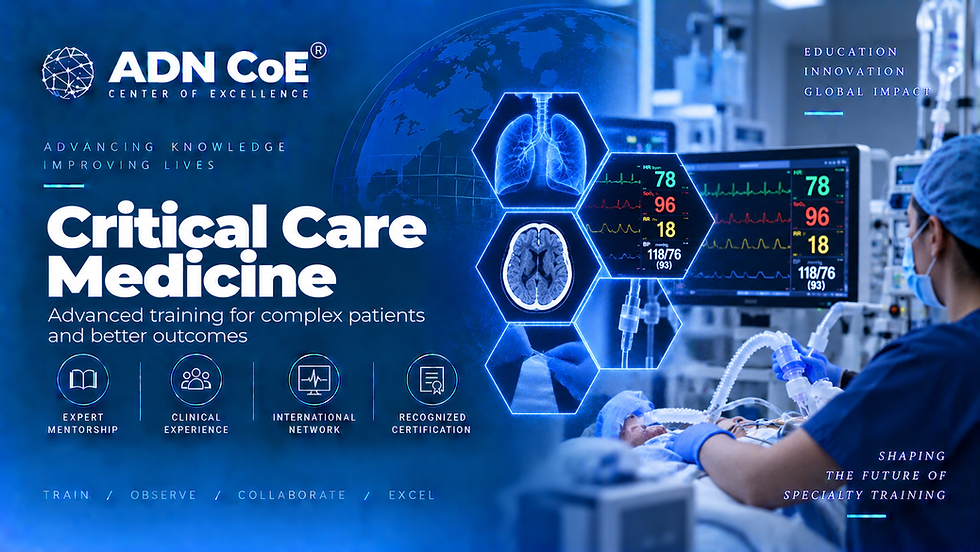
Specialty Overview
Critical Care Medicine focuses on the assessment, monitoring and management of patients with life-threatening illness, organ dysfunction and complex multisystem disease.
ADN CoE programmes are designed for physicians seeking structured exposure to contemporary intensive care practice. Depending on the selected pathway, participants may observe ICU workflows, engage in structured case-based learning or undertake a longer-term fellowship focused on longitudinal clinical and academic development.
Programmes may include exposure to respiratory failure, haemodynamic instability, sepsis, shock, mechanical ventilation, renal replacement therapy, sedation and analgesia, critical care ultrasound, neurological monitoring, organ support and multidisciplinary ICU decision-making.
Clinical Observership
Observe Contemporary Intensive Care Practice
The Critical Care Medicine Clinical Observership is designed for physicians who wish to observe how intensive care teams assess, monitor and manage critically ill patients in real clinical environments.
The programme is primarily observation-based and focuses on understanding ICU workflows, organ-support strategies, multidisciplinary communication and critical-care decision-making.
Clinical Exposure May Include
Initial assessment of critically ill patients
ICU admission and triage workflows
Sepsis and septic shock management
Haemodynamic assessment
Vasopressor and inotrope use
Mechanical ventilation strategies
Non-invasive respiratory support
Airway management workflows
Arterial blood gas interpretation
Fluid management
Acute kidney injury assessment
Renal replacement therapy workflows
Sedation, analgesia and delirium management
Nutritional support
Critical care ultrasound exposure
Neurological monitoring
Infection prevention and antimicrobial stewardship
Multidisciplinary ICU rounds
Family communication and goals-of-care discussions
Post-ICU and step-down planning
Educational Format
Participants observe intensive care practice under the supervision of experienced faculty and may attend appropriate ward rounds, handovers, multidisciplinary meetings, case discussions and departmental educational sessions.
The observership does not provide independent patient-care authority or replace local licensing, institutional credentialing or recognised specialist training requirements.
Best Suited For
Physicians seeking:
Short-term exposure to modern intensive care practice
Familiarity with ICU workflows and monitoring
Observation of organ-support strategies
Exposure to multidisciplinary critical-care decision-making
International professional development without undertaking a long-term programme
Clinical Immersion
Move Beyond Observation into Structured Critical-Care Learning
The Critical Care Medicine Clinical Immersion Programme provides a more intensive educational experience than a standard observership.
Participants receive structured faculty interaction, guided case review and focused clinical learning while remaining within the boundaries of local institutional, professional and licensing requirements.
The programme is designed to help participants understand not only what critical-care teams do, but also how physiological data, organ dysfunction and evolving clinical risk influence management decisions.
The Programme May Include
Structured review of critically ill patients
Faculty-guided case discussions
Shock and haemodynamic reasoning
Sepsis-management strategy review
Mechanical ventilation case analysis
Ventilator waveform interpretation
Oxygenation and ventilation strategy discussions
Fluid-responsiveness assessment
Vasopressor and inotrope strategy review
Acute kidney injury case discussions
Renal replacement therapy principles
Sedation, analgesia and delirium management
Critical care ultrasound interpretation
Neurological deterioration case review
ICU infection and antimicrobial discussions
Nutrition and metabolic support
Organ-support prioritisation
Multidisciplinary decision-making
End-of-life and goals-of-care considerations
Educational Emphasis
Clinical immersion focuses on:
Observe → Assess → Analyse → Discuss → Apply
Participants are encouraged to analyse ICU cases, interpret monitoring data and discuss diagnostic and management strategies directly with faculty rather than functioning solely as passive observers.
Best Suited For
Physicians who want:
More intensive exposure than an observership
Structured interaction with critical-care faculty
Case-based physiological reasoning
Greater understanding of organ-support strategies
Exposure to complex ICU decision-making
Focused professional development without committing to a long-term fellowship
Clinical Fellowship
Longitudinal Training in Critical Care Medicine
The Critical Care Medicine Clinical Fellowship is the most comprehensive educational pathway within the specialty.
It is designed for physicians seeking sustained exposure to intensive care practice and progressive development in physiological interpretation, organ-support management, clinical reasoning and multidisciplinary critical-care decision-making.
Unlike a short observership or clinical immersion programme, the fellowship follows a longitudinal educational model, allowing participants to encounter a broader spectrum of critically ill patients and understand how management strategies evolve over time.
Fellowship Focus Areas May Include
Sepsis and septic shock
Cardiogenic and distributive shock
Acute respiratory failure
ARDS
Mechanical ventilation
Weaning and extubation
Non-invasive ventilation
High-flow nasal oxygen
Difficult airway management
Haemodynamic monitoring
Vasopressors and inotropes
Fluid and volume management
Acute kidney injury
Renal replacement therapy
Neurological critical care
Sedation and analgesia
Delirium management
Critical care ultrasound
Nutrition in critical illness
Infection management
Antimicrobial stewardship
Multiorgan failure
Postoperative intensive care
Peri-arrest and emergency management
ICU ethics and goals-of-care discussions
Post-intensive-care follow-up
Fellowship Learning Model
The fellowship may combine:
Longitudinal ICU case exposure
Faculty-guided case discussions
Daily multidisciplinary rounds
Physiological monitoring review
Ventilator and waveform interpretation
Critical care ultrasound review
Organ-support strategy discussions
Academic reading
Evidence-based guideline review
Clinical reasoning exercises
Case presentations
Morbidity and mortality meetings
Reflective learning
Structured faculty feedback
Where permitted by the host institution and applicable regulations, additional supervised educational activities may be incorporated. The precise scope of participation is determined by the host centre, participant background and local professional requirements.
Learning Objectives
By the end of the fellowship, participants should have developed a stronger ability to:
Approach critically ill patients systematically
Recognise and prioritise life-threatening organ dysfunction
Interpret haemodynamic, respiratory and metabolic data
Understand mechanical ventilation principles
Discuss appropriate oxygenation and ventilation strategies
Understand shock management and vasoactive therapy
Recognise indications for renal replacement therapy
Integrate ultrasound and monitoring findings into clinical reasoning
Understand sedation, analgesia and delirium-management principles
Recognise evolving sepsis and multiorgan dysfunction
Participate effectively in multidisciplinary ICU decision-making
Understand escalation, de-escalation and goals-of-care principles
Apply contemporary evidence and guideline recommendations to critical-care practice
Best Suited For
The fellowship is intended for physicians seeking:
Long-term structured development in critical care medicine
Broader exposure to complex ICU cases
Regular faculty interaction
Progressive learning over time
Deeper understanding of organ-support strategies
Greater exposure to physiological monitoring and critical-care reasoning
International professional and academic development

Durations
Available Institutions
